
The United States’ capacity to maintain a presence in the Arctic is so limited that, this summer, a single technical malfunction halved the Coast Guard’s icebreaking capability in the region.
This breakdown occurred at a time when Chinese vessels are intensifying their activities around Alaska.
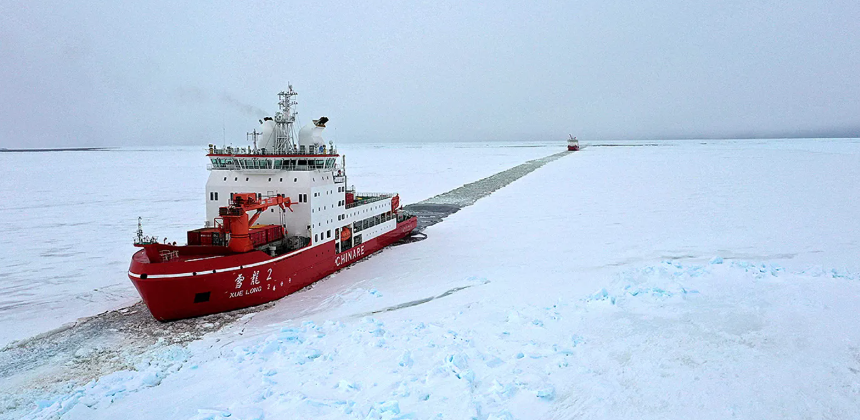
Rear Admiral Bob Little, commander of the Coast Guard’s Arctic District, told Fox News Digital that a mechanical failure aboard the Coast Guard cutter Healy left the service with only one operational icebreaker. Meanwhile, four Chinese research vessels were active in the same region.
“The sudden technical failure of the Healy cut my capacity to operate in the ice-covered domain by half,” Little stated.
This shortfall comes as the U.S. faces an increasing need to maintain a presence in these waters a region that can take days to reach. Chinese research vessels are gaining experience in the Arctic and collecting data that could have military applications, including for submarine operations. Simultaneously, Russia possesses a significantly larger icebreaker fleet, granting Moscow greater reach for moving vessels and supplies throughout the region.
The Coast Guard is now racing to bolster its fleet with additional ships, aircraft, and surveillance capabilities, as shrinking sea ice opens up more of the Arctic to navigation. However, its next generation of icebreakers remains years away.
“Given the current operational landscape,” Little remarked, “the sooner I can get those icebreakers, the better.” Little stated that recent funding amounting to approximately $25 billion will support the construction of 11 new Arctic Security Cutters, the first of which is expected to arrive in the region as early as 2028.
This development comes at a time when the operational scope of the Coast Guard is effectively expanding. The reduction in sea ice is opening up more navigable waters around Alaska, drawing commercial and military activity into areas that were previously difficult to access.
“As this new operational region becomes accessible,” Little said, “we are seeing an increase in human activity driven by economic development and military advancement. This activity, in turn, creates a greater need for the Coast Guard’s mission.”
China’s presence in these waters is rapidly becoming the norm. Little noted that Chinese research activity in the Arctic has grown from the occasional appearance of a single vessel to five vessels last year, with four operating there this year.
These vessels are not necessarily violating international law. The Coast Guard cutter Munro recently returned from a 112-day Arctic patrol which included monitoring Chinese research vessels and Little stated that the Coast Guard did not observe any surface activity that deviated from established law or international norms.
He added that the concern lies in what China might learn simply by operating in the region. “Any research vessel operating in the polar region has the capability to conduct scientific research,” Little said. “This could also include economic research aimed at the future exploitation of rare resources and critical minerals.”
He added, “Furthermore, all such research can support military activities for instance, if one is mapping the seabed or navigating underwater assets.”
Troy Bouffard, director of the Center for Arctic Security and Resilience at the University of Alaska Fairbanks, noted that China’s research activities provide Beijing with operational experience in an environment where it has historically had very little exposure.
“They are quite eager to gain operational experience and knowledge to support their growing military capabilities,” Bouffard told Fox News Digital.
He explained that while research vessels do collect legitimate scientific data, this information could also be put to other uses “especially when it comes to planning for submarine warfare.”
For the United States, Bouffard noted that the challenge extends well beyond the mere number of icebreakers. Unlike the North Atlantic where the U.S. and its allies possess decades of established infrastructure and experience there is very little infrastructure in place to support a sustained presence in the North Pacific sector of the Arctic.
“If we cannot maintain a surface presence in a given area, it becomes extremely difficult to manage issues that might arise there,” Bouffard said.
The vast distances only serve to exacerbate the problem. Bufford noted that it could take several days for a vessel to reach the Bering Sea from Kodiak, Anchorage, or Seattle.
Russia already holds a significant advantage in its ability to maintain access, as it possesses a much larger fleet of icebreakers.
“The advantage is certainly in their favor,” Little said.
He explained that Russia’s fleet enables it to maintain access, maritime routes, and logistical corridors for both commercial and military purposes.
“Certainly, when we look at military superiority, it is essential for the United States to maintain its position and ensure that we have a presence in the ice, as well as the capability to operate within it,” Little stated.
The Coast Guard is also monitoring cooperation between Moscow and Beijing. Little noted that the service has observed joint Russian-Chinese military surface groups, collaboration between their respective coast guard forces, and Chinese research vessels operating alongside Russian counterparts “potentially exchanging information.”
“It is important to pay attention to each of these individually,” Little said. “But whenever they operate together, we monitor them closely to see whether they pose a threat to homeland security or a military risk to the United States.”





One Comment